
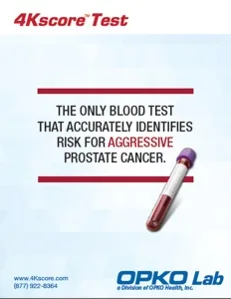
Dr. Robbins began using the 4Kscore from OPKO Lab in 2015 to help detect high-grade prostate cancer and to help men avoid prostate biopsies they do not need.
Why biopsy more selectively
When this post was written, the U.S. Preventive Services Task Force had recommended against PSA screening for all men (2012). Its current recommendation, from 2018, is that for men aged 55 to 69 the decision to be screened should be an individual one, and it recommends against PSA screening at 70 and older.2 Part of what drove the debate was overtreatment of low-grade cancers that would never have caused harm. The answer we favoured then, and still do, is set out below in Dr. Robbins’ words.
That is also where today’s urology guideline lands: screen with a conversation, then use additional tests to decide who actually needs a biopsy.3
What the 4Kscore measures
The 4Kscore Test, often written “4K score”, combines four blood measurements (total PSA, free PSA, intact PSA and human kallikrein 2) into one number that also takes in the patient’s age, whether he has had a biopsy before, and the result of the digital rectal exam. It is designed to estimate the chance of aggressive prostate cancer, meaning Gleason score 7 or higher (Grade Group 2 or higher), rather than the chance of any cancer at all.1 In 2025 the FDA approved a version of the test for when a rectal exam result is not available.1
Who it is for
The FDA approved the 4Kscore Test in December 2021. It is indicated, together with other patient information, as an aid in deciding on a prostate biopsy in men 45 and older who have an abnormal age-specific PSA and/or an abnormal digital rectal exam, and for whom a urologist would otherwise recommend a biopsy. The test is not recommended more than once every six months, and it is performed at a single laboratory, BioReference.1
In practice, that means the 4Kscore can be useful before a first biopsy in a man with a raised PSA or an abnormal exam, and in a man with a previous negative biopsy who is considering a second one.13
What the guidelines say
The AUA/SUO guideline on early detection of prostate cancer (2023, amended 2026) recommends shared decision-making about screening and PSA as the first test. When a PSA is newly elevated, it advises repeating it before moving on to a biomarker, imaging or a biopsy.3 It then allows that clinicians “may use adjunctive urine or serum markers when further risk stratification would influence the decision regarding whether to proceed with biopsy,” and lists the 4Kscore among the available blood tests, for both first and repeat biopsy decisions.3
The guideline is also candid about the trade-off. In general these tests are calibrated so that skipping a biopsy when the result is below the threshold avoids about one-third of biopsies, at the cost of delaying or missing 5% to 10% of clinically significant cancers. It advises against using a biomarker when the risk is already so low, or so high, that the result would not change the decision; for example, a man with a prostate nodule, a PSA above 10 or a strong family history of high-grade cancer will usually go to biopsy anyway.3
Reading a result
According to the FDA approval, a 4Kscore below 5.0 is associated with a lower likelihood of finding a Gleason 7 or higher cancer on biopsy. It does not diagnose or rule out cancer; only a biopsy can do that.1 A low result can support a decision to keep monitoring instead of biopsying now. A higher result strengthens the case for an MRI and a biopsy. Either way, the result is one input to a decision you make with your urologist.
If you need a biopsy
For men whose clinical picture and 4Kscore point toward a biopsy, an MRI first can show whether there is a suspicious area. If there is, an MRI-ultrasound fusion targeted biopsy lets the needle be aimed at it. The AUA/SUO guideline supports MRI before a first biopsy and targeted biopsy of suspicious lesions.3
Sources
- U.S. Food and Drug Administration. 4Kscore Test, premarket approval P190022.
- U.S. Preventive Services Task Force. Prostate Cancer: Screening.
- Wei JT, Barocas D, Carlsson S, et al.; amendment panel Lin DW, et al. Early Detection of Prostate Cancer: AUA/SUO Guideline (2023, amended 2026).