Services
MRI Ultrasound Fusion Targeted Prostate Biopsy Miami, FL

A targeted prostate biopsy fuses MRI and ultrasound to provide a more precise way to look for prostate cancer
Prostate cancer can be difficult to detect and deciding what to do about it once it is diagnosed can be even tougher on both patients and physicians. When aggressive prostate cancer is discovered, we want to be able to treat the patient with prompt and aggressive therapy to provide a cure, however, we also don't want to subject patients with low grade and indolent prostate tumors to overly aggressive treatments that may have side effects and impair quality of life without and a clear benefit to the patient's health.
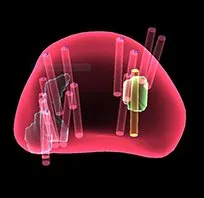
Fortunately, an innovative technology exists that helps urologists to both diagnose prostate cancer and to help differentiate between aggressive and indolent disease. This innovative technology is called a Targeted Prostate Biopsy. Targeted biopsies fuse a prostate MRI with real-time prostate ultrasound to more precisely target prostate cancer during a biopsy. At Urological Consultants of Florida, we have been providing patients with the opportunity to have this more modern type of biopsy for years. In fact, at Urological Consultants of Florida, we are one of the first centers in South Florida to offer patients MRI Ultrasound Fusion Targeted Prostate Biopsy.
What are some of the drawbacks of a traditional random prostate biopsy?
The traditional transrectal ultrasound-guided prostate biopsy technique has not changed for decades. Although real-time prostate ultrasound is used during the biopsy, ultrasound is not able to differentiate areas of prostate cancer versus benign prostate tissue and so urologists typically choose between 12 and 24 random areas to perform needle biopsies. This technique is essentially blind and so the urologist may miss areas of aggressive cancer outside of the traditional prostate biopsy grid or the biopsy may lead to the diagnosis of random areas of inconsequential prostate cancer resulting in unnecessary treatments for patients.
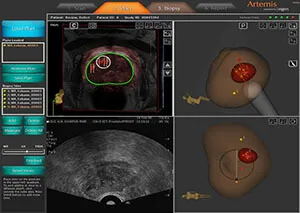
Why is MRI ultrasound fusion targeted prostate biopsy an improvement over the traditional biopsy?
An MRI is significantly better than an ultrasound at detecting areas of concern in the soft tissue of the prostate. Although the MRI cannot make the diagnosis of prostate cancer, it can highlight suspicious areas that warrant further investigation with a prostate needle biopsy. MRI scanners however are not readily available in urology offices and their cost and bulkiness make them difficult to consider as ideal locations to perform a prostate biopsy. With the above, considerations in mind, researchers have developed software that allows urologists to fuse the MRI images of the prostate obtained in imaging centers with the images obtained during real-time, in office, transrectal ultrasound. This allows the urologist to be able to target the areas of greatest concern on MRI while performing an office-based prostate biopsy. During the office-based ultrasound, the suspicious areas from the MRI area laid on top of the ultrasound images in a 3 dimensional and color-coded pattern, allowing the urologist to easily target them with a biopsy needle.
What has research shown us about the benefits of Targeted Fusion biopsy over a traditional random prostate biopsy?
Research has shown that targeted prostate biopsy misses almost as many prostate cancers as a traditional prostate biopsy, however, these missed tumors tend to be low aggressiveness inconsequential tumors that likely do not need treatment. More importantly, targeted biopsy with MRI and ultrasound fusion has been shown to find more of the aggressive tumors — the ones that actually need treating. Using a modern MRI and ultrasound fusion biopsy technique, urologists can target more aggressive prostate cancers and make a diagnosis during the first biopsy and avoid a biopsy or a repeat biopsy in those individuals without cancer or inconsequential cancers.
First, which biopsy
There are two different biopsies, and they are not the same appointment
Not every prostate biopsy is a fusion biopsy, and the two are quite different experiences. It is worth knowing which one you are booked for, because the preparation is not the same.
The standard biopsy — in our office
Performed here at our North Miami office using ultrasound guidance through the rectum, under local anesthetic. You are awake, it takes a matter of minutes, and you drive yourself home. There is no MRI overlay: samples are taken systematically from across the gland rather than aimed at a specific target.
The MRI-fusion targeted biopsy — the one this page describes
You have an MRI first. Those images are then fused with live ultrasound so that samples can be aimed directly at the areas the MRI flagged. We perform this one through the perineum rather than the rectum, and under sedation or general anesthesia — so it needs fasting beforehand and someone to drive you home.
Which of the two is right for you depends on your own situation, including whether you have had an MRI, what it showed, and whether you have been biopsied before. That is decided with you at your consultation, and we will tell you plainly which one you are having and why.
Before you come in
What to expect at a fusion biopsy
We perform targeted biopsies using a transperineal approach: the needle passes through the skin between the scrotum and the anus rather than through the wall of the rectum. That route matters. Because the needle never crosses the bowel, the risk of serious infection is considerably lower than with the older transrectal technique.
The biopsy is done under sedation or general anesthesia — you are asleep and will not feel it. That means two practical things: you will be asked not to eat or drink for a period beforehand, and you must arrange for someone to take you home. You cannot drive yourself, and you should not plan to work that day.
You will be told which blood thinners to stop and when. Do not stop any medication on your own — that decision is made together with us and, where relevant, with the doctor who prescribed it.
The procedure itself takes around twenty to thirty minutes. An ultrasound probe images the prostate, the MRI taken earlier is overlaid on that live picture, and samples are taken from the areas the MRI flagged as suspicious as well as from the rest of the gland. You go home the same day.
Your results
Results take about a week. You will hear them from your urologist — if the news is difficult, you are told it by a doctor who can answer your questions in the same conversation, not by a portal notification you read alone at night.
Afterwards
Expect some blood in the urine for a few days, and blood in the semen for rather longer — several weeks is normal, it can look alarming, and it is not dangerous. Soreness or bruising where the needle went in usually settles within a day or two. Most men are back to ordinary activity the next day, avoiding heavy lifting and strenuous exercise briefly.
When to call us straight away
Serious problems are uncommon with a transperineal biopsy, but three things should not wait:
- You cannot pass urine at all. Temporary swelling can block the flow. This is the most common reason men come back after a transperineal biopsy, it is straightforward to treat, and it needs treating the same day.
- Fever, chills, or feeling generally unwell. Infection is much less likely by this route than by the transrectal one, but it is not impossible, and it is not something to sleep on.
- Heavy bleeding rather than the expected streaks — passing clots, or bleeding that is getting worse instead of better.
Call (305) 672-4222. Out of hours, or if you feel very unwell, go to an emergency room and tell them you have had a prostate biopsy.
If you are reading this because a PSA result came back abnormal, it is worth understanding what an abnormal PSA does and does not mean first. If a biopsy has already found cancer, the treatment options are set out here — and a diagnosis is not a decision you have to make this week.
Why we do it this way
In Dr. Robbins’ words
“A traditional 12-core prostate biopsy randomly samples the prostate with the hopes of a chance encounter with prostate cancer tissue. In a small prostate, or one with more advanced and diffuse disease, prostate cancer will usually be discovered that way. But when the prostate is large, or the disease is focal or anterior, it will often be missed in a random 12-core sampling.”
“Current MRI imaging allows for precise localization of areas in the prostate that are suspicious for cancer in men with an elevated or rising PSA. Fusion targeting lets me sample those specific areas while using real-time ultrasound — making it more likely to find a cancer that a traditional biopsy would have missed.”
David Robbins, MD — who trained in MRI-ultrasound fusion technique at NYU Medical Center, where much of the research validating it was carried out
Contact Us
We’re here to help. Schedule your visit or ask a question today.
No question is too small — and nothing you share here surprises us. Reach out however feels easiest.
- Call(305) 672-4222
- Visit12411 Biscayne Boulevard
North Miami, FL 33181 - HoursMonday–Friday, 9:00 am – 5:00 pm

Your message goes to Dr. Robbins’ own team — you’ll hear back within one business day.
Get More Information
Need us sooner? Call (305) 672-4222.
We’re Here When You Need Us
Our Office
Visit us in North Miami, or call to book your appointment.
North Miami
- Address12411 Biscayne Boulevard
North Miami, FL 33181 - Phone(305) 672-4222
- Fax(305) 944-3624
| Monday – Friday | 9:00 am – 5:00 pm |
| Saturday – Sunday | Closed |

Prostate Cancer Care at UCOFL
In This Section
Associations
Proud Members Of