Vasectomy & Reversal · Vasectomy Reversal
Vasectomy Reversal in Miami, Florida - Dr. David Robbins
A new partner. A second chance. A decision made years ago that no longer fits the life you have now. The road can usually be reopened — here is how, honestly: the odds, the operation, the cost, and the other road.
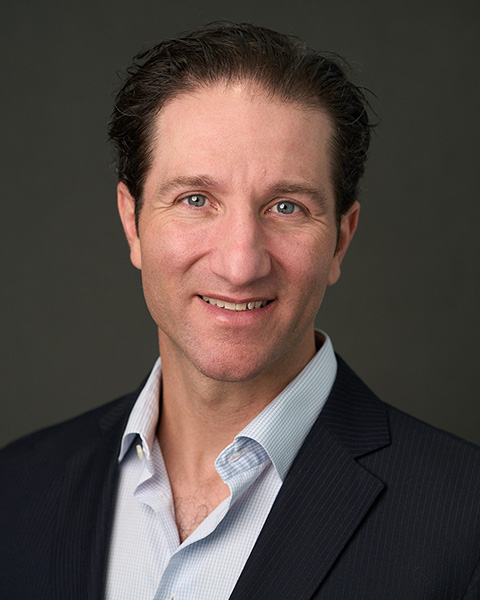
 David Robbins, MD — Diplomate, American Board of Urology
- Serving South Florida for 40+ Years
- Board-Certified Urology
- Diplomate, American Board of Urology
- Minimally Invasive Specialists
- North Miami, Florida
Why you are here
Considering a Vasectomy Reversal?
Most men who sit in this chair are here for one of three reasons. A new relationship, and a partner who wants a child with you. A loss — a child, a marriage — and a life that has reorganised itself around something you could not have planned for. Or simply a change of heart: the decision was right at thirty and is wrong at forty.
Whichever it is, the first thing to know is that the vasectomy did not switch anything off. The testis has been making sperm every day since. The body quietly reabsorbs them. A vasectomy removed a short piece of road and sealed both ends; a reversal rejoins them. That is the whole idea, and it is why a reversal is still possible fifteen or twenty years later.
The sperm pathway
Sperm are made in the testis and mature in the epididymis; the vas deferens carries them onward. A vasectomy removes a short segment of the vas and seals both ends. A reversal rejoins them.
A schematic of the testis, the epididymis along its back, and the vas deferens rising from it. Three states: before vasectomy the tube is continuous and a pulse travels its full length; after vasectomy a short segment is missing and both ends are sealed, so the pulse stops; after reversal the ends are rejoined with fine sutures and the pulse travels through again.
Before vasectomy: sperm travel from the testis, through the epididymis, up the vas deferens.
After a vasectomy the testis keeps making sperm; the body reabsorbs them. That is why a reversal is possible years later — the supply was never switched off, only the road. How far upstream the road has silted up over the years is what the surgeon checks during the operation (graphic A, step 2). Schematic, not to scale; one side shown.
Dr. David Robbins is a board-certified urologist who performs both vasectomy and vasectomy reversal at Urological Consultants of Florida in North Miami. If you are reading this as the partner: this page is written for you too. The decision belongs to both of you, and two of the three things that predict how well a reversal works are about time — his years since the vasectomy and your age — which is why the sections below say so plainly.
In Dr. Robbins’ words
What Makes Dr. Robbins an Expert in Vasectomy Reversal?
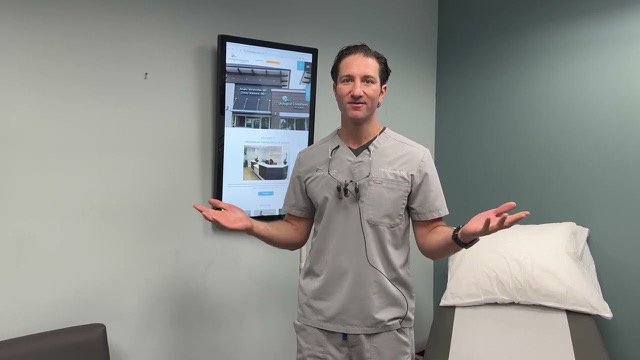
“I perform more than five hundred vasectomies a year, and I reverse them. Those two facts belong together. The surgeon who reverses a vasectomy should know, from the inside, exactly what was done to the vas in the first place — where it was cut, how it was sealed, what scar that leaves — because the reversal begins by removing that scar and finding healthy tube on either side.
“Here is what happens on the day. Once the two ends are prepared, I take the fluid from the testicular side and look at it under the microscope. If there are sperm in it, the road between the testis and that point is open, and I rejoin the vas to the vas. If there are none, the blockage has probably formed further back, in the epididymis, where the textbook operation is a finer one: the vas joined to a single tubule of the epididymis, a vasoepididymostomy, which I refer for. The American Urological Association’s 2026 guideline asks the surgeon to check that fluid. When I find no sperm, I usually still complete the vas-to-vas join, because sperm can return after it, though less often. That is a decision I make with you, not for you: we talk it through at your consultation, before the day of surgery, so you know exactly what I will do if it happens.
“What I advise against. Choosing a reversal by price alone — the cheapest operation in the state is not cheaper if it has to be done twice. Letting the man decide alone — the partner’s age is one of the three strongest predictors of whether a reversal leads to a pregnancy, so she is part of the conversation from the first visit. And waiting to ‘see how things go’ when she is over thirty-five: that is the one situation where months matter.
“What I tell couples at the first visit: I will give you the published numbers for your interval, and I will tell you honestly how your situation compares. And if the other road — retrieving sperm and using IVF — is the better road for the two of you, I will say so and refer you to a fertility specialist who does it, because I would rather you have a child than have an operation.”
Published outcomes
How Successful Are Vasectomy Reversals?
Two things are measured after a reversal. Whether sperm return to the semen — patency — and whether a pregnancy follows. The first is mostly about the operation. The second has two people in it.
The landmark multicentre series, the Vasovasostomy Study Group’s 1,469 reversals, found the strongest predictor was time: the longer since the vasectomy, the lower both numbers — though even at fifteen years or more, sperm returned in seven men out of ten. Drag the marker below to your own interval.
Published outcomes by obstructive interval
Return of sperm and pregnancy after a first-time microsurgical reversal, by years since the vasectomy — the landmark Vasovasostomy Study Group series.
Two gauge cylinders show published rates by obstructive interval. Under 3 years: sperm returned in 97 percent, pregnancy in 76 percent. 3 to 8 years: 88 and 53 percent. 9 to 14 years: 79 and 44 percent. 15 years or more: 71 and 30 percent.
Sperm returned in 97% of men; pregnancy followed in 76% of couples with follow-up.
Source: Belker AM, Thomas AJ, Fuchs EF, Konnak JW, Sharlip ID. Results of 1,469 microsurgical vasectomy reversals by the Vasovasostomy Study Group. J Urol 1991;145:505–11 (PMID 1997700) — first-time reversals; pregnancy counted among the 810 couples with follow-up. A 2026 eight-centre cohort (4,568 men) found one-year patency ranging from 54% to 93% between surgeons, median 82% (Lipshultz et al., Fertil Steril 2026, PMID 42252049). These are published figures, not this practice’s results; pregnancy also depends on the partner, and no reversal can promise one.
One more honest number. In 2026, eight centres pooled 4,568 reversals and found that one-year patency varied from 54% to 93% depending on the surgeon. The surgeon is a variable. That is the reason to ask any surgeon how he performs the operation and how he follows you afterward — and at your consultation, Dr. Robbins will walk you through both.
The operation
What Can You Expect During the Procedure?
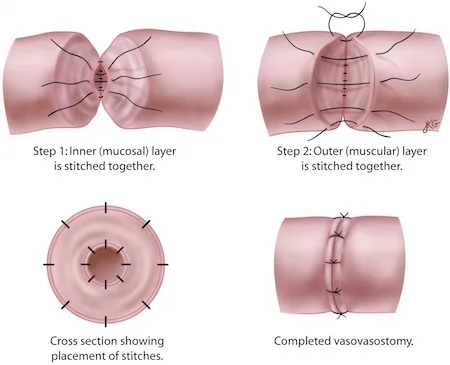
A vasectomy reversal uses microsurgical technique under loupe magnification: Dr. Robbins operates wearing 4.5× surgical loupes (magnifying lenses), through a small incision on each side. The scarred segment from the vasectomy is removed, the fluid is examined, and the two ends are rejoined with 9-0 nylon sutures, finer than a human hair — the inner lining first, then the muscular wall over it, so the channel is aligned and watertight. The whole sequence is drawn below, as the surgeon sees it.
How a reversal is done
The reversal, as the surgeon sees it: two cut ends of the vas, the fluid checked for sperm, the inner lining and outer wall stitched in turn, and the channel open again.
Diagram of a vasectomy reversal in four steps: two cut ends of the vas deferens drawn as shaded tubes facing each other; a drop of fluid examined for sperm; fine sutures joining the inner lining and then the outer wall; and a pulse travelling through the rejoined channel. A toggle shows the alternative operation, vasoepididymostomy, where the vas is joined to a single tubule on the side of the epididymis.
The scarred segment from the vasectomy is cut away, leaving two healthy ends.
Vas-to-vas (vasovasostomy) is the usual operation. When the fluid from the testis side shows no sperm, the blockage is further upstream and the vas is joined instead to a single tubule of the epididymis (vasoepididymostomy) — a finer anastomosis. The AUA guideline (2026) asks surgeons to check the fluid microscopically (Statement 23) and to be able to perform either operation (Statement 25). Schematic, not to scale. Vasoepididymostomy is not performed at this practice: when the blockage is higher, at the epididymis, it is a procedure we refer for.
In the Study Group’s series, when no sperm were found in the fluid on either side and a vas-to-vas join was done regardless, sperm returned in only 60% — which is why the finer operation matters (Belker et al., 1991). When the blockage is higher, at the epididymis, a different reconnection — vasoepididymostomy — is needed, and that is a procedure we refer for.
The operation is performed under local anesthetic, here in the office; it takes about three to four hours, and you go home the same day. Expect a thorough consultation first — your vasectomy date and record, an examination, and a plan for what happens if the fluid shows the blockage is higher, because that is only known once the fluid is examined.
After surgery
Successful Return of Sperm After Vasectomy Reversal
Sperm do not reappear overnight. After a vas-to-vas join they are usually seen within the first months; after a vas-to-epididymis join it takes longer, and the chance is lower. We check with a first semen analysis at about two months, then at intervals until the count is stable.
The 2026 multi-centre study found that the one-year semen analysis is the measurement that most clearly tells surgeons apart — earlier tests flatter everyone. So the honest yardstick for any reversal, including ours, is sperm in the semen at one year. If the count is there and no pregnancy has followed, the next conversation is about both partners, and often includes a fertility specialist.
The other road
Reversal, or sperm retrieval with IVF?
There are two ways to a pregnancy after a vasectomy, and the guidelines say couples should hear about both. One is to reopen the road — the reversal — and conceive naturally. The other is to leave the road closed, retrieve sperm directly from the testis or epididymis in a minor procedure, and use them in an IVF cycle with ICSI. The AUA and ASRM add a third: do the reversal and freeze sperm at the same operation, so the second road stays open if the first does not deliver.
What tips it is rarely one thing. Years since the vasectomy. Her age — female fertility declines gradually from the early thirties and more rapidly after thirty-seven, and over forty the professional advice is not to wait. How many children you hope for: a reversal is one operation that can allow more than one natural pregnancy; IVF is one attempt at a time. And whether IVF would be needed anyway for a reason of her own, in which case retrieving sperm at the same time spares him an operation.
Move the factors below and watch which road each one lights. Then bring the result to us. This is a decision the two of you make with Dr. Robbins — and often with a fertility specialist in the room. Sperm retrieval and IVF are done by fertility specialists, not at this practice: we talk the choice through with you at your consultation and refer you when that road is the better one.
Two ways to a pregnancy after vasectomy
Two roads from the same starting point. Each factor lights a lamp on the road it tends to favour; the decision is the couple’s, usually with a fertility specialist in the room.
An isometric diagram of two roads leaving one point: the left leads to reversal, the right to sperm retrieval with IVF. Four factors — years since vasectomy, partner’s age, number of children hoped for, and whether IVF is needed anyway — each light a lamp on one road or the other.
- Under 3 years: patency 97%, pregnancy 76% in the largest series — the interval favours reversal.
- Partner under 35: time is on your side; natural conception after reversal is a reasonable first road.
- More than one child hoped for: one reversal can allow more than one natural pregnancy; IVF is per attempt.
- No other reason for IVF: either road remains open.
Both roads are recognised options: the AUA/ASRM male-infertility guideline (2020, amended 2024) says couples should be counselled that “surgical reconstruction, surgical sperm retrieval, or both reconstruction and simultaneous sperm retrieval for cryopreservation are viable options” (Statement 35). The AUA vasectomy guideline (2026) names the obstructive interval, the man’s age and the female partner’s age as “the best preoperative predictors” of reversal success (Statement 22). Female fertility “decreases gradually but significantly beginning approximately at age 32 years and decreases more rapidly after age 37 years” (ACOG Committee Opinion 589, 2014). Interval figures: Belker et al., J Urol 1991. This graphic organises a conversation; it is not a recommendation for any one couple. Sperm retrieval and IVF are done by fertility specialists, not at this practice; we talk the choice through with you at your consultation and refer you when that road is the better one.
Cost
Affordable Vasectomy Reversal by David Robbins, MD
A vasectomy reversal at Urological Consultants of Florida is one all-inclusive fee: $5,900. It covers:
- the surgeon’s fee;
- the procedure room, in our office;
- the local anesthetic;
- your post-operative visits.
One thing is billed separately: the semen analyses after surgery are done by an outside laboratory, which bills you or your insurance directly. Most insurance plans do not cover the reversal itself; we will tell you if yours is an exception.
Why we publish it. Because the first thing most couples search is the cost. For comparison in kind rather than in dollars: a reversal is paid once and can allow more than one pregnancy; IVF is paid per cycle, and the sperm retrieval is a separate procedure. Which is the better value is a question about your family, not our fee.
Recovery
Comprehensive Postoperative Care After Vasectomy Reversal
At Urological Consultants of Florida, we prioritize your recovery and well-being after a vasectomy reversal. You leave with detailed instructions and personalized follow-up appointments. We provide guidance on pain management, activity restrictions, and what to expect during your recovery period, and our team is available to address any concerns along the way.
- Home the same day.
- Rest, ice and supportive underwear for the first days.
- Desk work right away, as soon as you feel ready.
- No heavy lifting or strenuous exercise for two to four weeks — less for the discomfort than to protect the join while the vas heals, which is what the result depends on.
- No intercourse or ejaculation for two to three weeks.
- A first semen analysis at about two months, then at intervals through the first year.
Facts you can check
Why Choose Urological Consultants of Florida?
Compassionate, patient-centered care is a promise. These are lookups.
- Diplomate, American Board of Urology (certification ID 17502).
- Florida medical license ME103781.
- NPI 1588848683.
- In practice since 2009.
- More than 500 vasectomies a year.
- Teaching surgical technique internationally since 2012.
- Director of Vasectomy Services, Southeast and North Florida.
The practice has served South Florida since 1982. Dr. Robbins has been part of it since 2009.
Questions couples ask
Frequently Asked Questions
How much does a vasectomy reversal cost in Miami?
At Urological Consultants of Florida a vasectomy reversal is one all-inclusive fee of $5,900: the surgeon's fee, the procedure room in our office, the local anesthetic and your post-operative visits. The semen analyses afterward are done by an outside laboratory and billed separately. Most insurance plans do not cover the reversal itself; we check yours.
My vasectomy was more than 15 years ago. Is it too late?
Usually not. In the landmark Vasovasostomy Study Group series of 1,469 reversals, sperm returned in 71% of men whose vasectomy was 15 or more years earlier, and pregnancy followed in 30% of couples with follow-up (Belker et al., J Urol 1991). The odds are lower than at three years, and the finer vas-to-epididymis operation becomes more likely — which is why the fluid is checked during surgery.
Does insurance cover vasectomy reversal?
Rarely. It is usually an out-of-pocket procedure; we will check your plan and tell you plainly.
How soon can we try for a pregnancy?
Intercourse is usually fine after two to three weeks, once you are healed. Sperm take longer to return: the first semen analysis is at about two months, and we confirm the count with further analyses over the following months. The one-year semen analysis is the honest measure of the operation itself.
What if the reversal doesn’t work?
If sperm do not return, a pregnancy is still possible: sperm can be retrieved directly by a fertility specialist and used with IVF. Dr. Robbins will talk it through with you and refer you.
What happens if no sperm are found in the fluid during surgery?
It usually means the blockage is further back, in the epididymis, where the textbook operation is a finer vas-to-epididymis join (vasoepididymostomy). That operation is not performed at this practice; we refer for it. Dr. Robbins usually still completes the vas-to-vas join, because sperm can return after it, though less often: in the Vasovasostomy Study Group series, sperm returned in 60% of men with no sperm in the fluid on either side (Belker et al., J Urol 1991). It is a decision made with you, discussed at your consultation before the day of surgery. Sperm take longer to return after a vas-to-epididymis join; in one 2026 series positive semen analyses followed 92% of two-sided vas-to-vas joins and 52% of two-sided vas-to-epididymis joins (Maloney et al., Andrology 2026).
Can sperm be frozen during the reversal?
It can be, though not at this practice. The AUA/ASRM guideline lists reconstruction with simultaneous sperm retrieval for cryopreservation as an option, which keeps the IVF road open if the reversal does not deliver. Sperm retrieval and freezing are done by fertility specialists; if you want sperm stored, we will discuss it at your consultation and refer you.
Reversal or IVF — how do we choose?
Together, with the factors in the section above: years since the vasectomy, her age, how many children you hope for, and whether IVF is needed anyway. Dr. Robbins will give you his view and, where it helps, refer you to a fertility specialist.
A note from a patient
“It happened again”
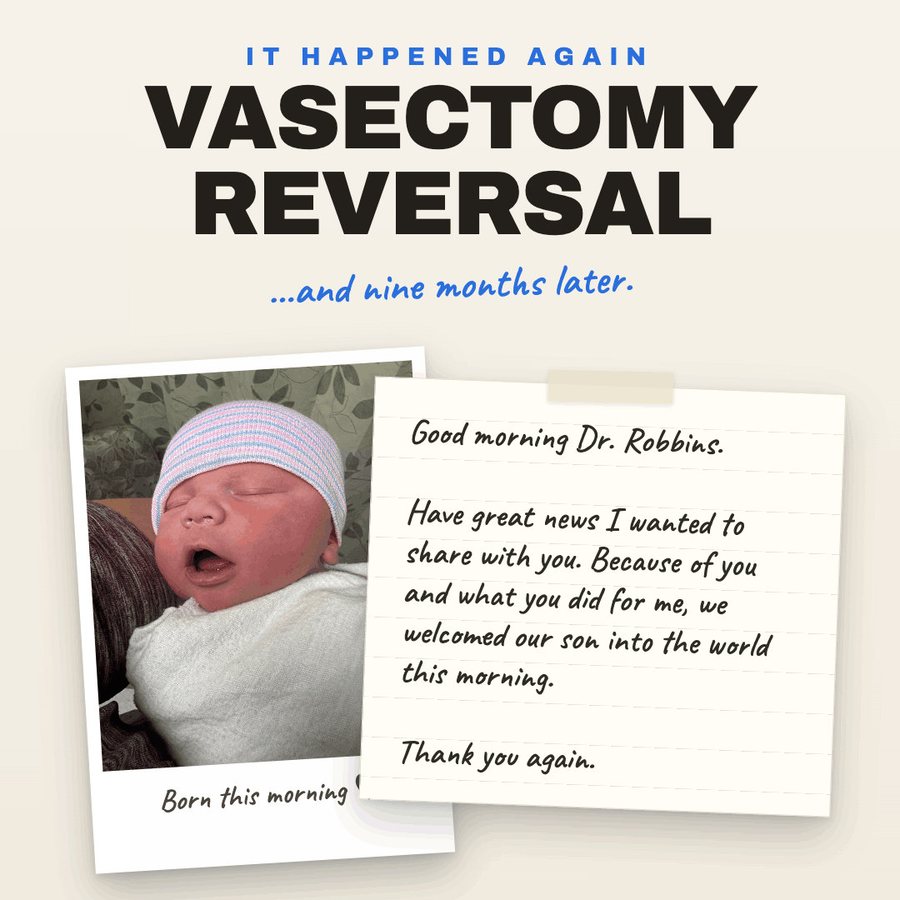
Good morning Dr. Robbins.
Have great news I wanted to share with you. Because of you and what you did for me, we welcomed our son into the world this morning.
Thank you again.
Individual results may vary. Vasectomy reversal outcomes depend on the time since the original vasectomy, individual health and other factors; a reversal cannot guarantee a pregnancy.
Contact Us
How to Contact Us and Make an Appointment?
No question is too small. Bring your partner. Bring the date of your vasectomy. We’ll take it from there — or call (305) 672-4222 and ask.
- Call(305) 672-4222
- Visit12411 Biscayne Boulevard
North Miami, FL 33181 - HoursMonday–Friday, 9:00 am – 5:00 pm
Your message goes to Dr. Robbins’ own team — you’ll hear back within one business day.
Get More Information
Need us sooner? Call (305) 672-4222.
We’re Here When You Need Us
Our Office
Visit us in North Miami, or call to book your appointment.
North Miami
- Address12411 Biscayne Boulevard
North Miami, FL 33181 - Phone(305) 672-4222
- Fax(305) 944-3624
| Monday – Friday | 9:00 am – 5:00 pm |
| Saturday – Sunday | Closed |

Vasectomy Care at UCOFL
In This Section
Associations
Proud Members Of