Men’s Sexual Health · Penile Implant
The Penile Implant Procedure: What to Expect
One small incision above the penis. General anesthesia. Home the same day, without a catheter. Here is the operation in the order you will actually experience it — including the part of it Dr. Robbins does differently, which you can watch him perform.

Most men reading this have already been through the other treatments. Pills worked, then worked less, then stopped. Perhaps injections after that. An implant is where the ladder ends. It works mechanically, which is the whole point of it: unlike pills and injections, it does not depend on blood flow, on timing, or on a drug working on the day.
It is also a real operation, and men research it seriously before committing. So this page is written the way the conversation goes in the office: what happens, in what order, and what you will and will not wake up with. If you are still deciding whether an implant is the right step at all, the candidacy page is the better place to start.
Step one
Before surgery
Implant surgery is planned, never urgent. That is an advantage: there is time to do the preparation properly, and time for you to change your mind.
Between deciding and operating, three things happen. You are medically cleared for a general anesthetic — which for most men means routine bloodwork and, depending on your history and age, clearance from the physician who manages your other conditions. Your medication list is reviewed, because some medicines, particularly blood thinners, need managing around surgery. And the practical arrangements get made: the operation is done under general anesthesia, so somebody must drive you home.
Your specific pre-operative instructions come from this office, in writing, before the day. They cover when to stop eating and drinking, which medications to hold and which to take, and how to wash beforehand — and they are tailored to you and your medication list rather than copied off a website. If anything on that sheet is unclear, call us. Getting it right matters more than getting it fast.
Step two
The day of surgery
Surgery is performed at Jackson North Medical Center in North Miami Beach, where Dr. Robbins holds surgical privileges. It is a full-service hospital, which matters less for a straightforward implant than it does on the rare occasion when something is not straightforward.
The operation is done under general anesthesia — you are fully asleep, with an anesthesiologist present throughout, and you feel nothing. This is not a procedure done under local anesthetic in an office.
It is outpatient surgery. You arrive in the morning, you have the operation, you recover from the anesthetic, and you go home the same day. You do not stay overnight.
And — because this is the question men ask most often, and the assumption most of them arrive with — no urinary catheter is used. Catheters are common after other urological operations, so many men expect to wake up with one. For this operation, with this technique, you do not.
Step three
One incision, three components
An inflatable penile prosthesis has three parts: a pair of cylinders inside the erectile bodies of the penis, a small pump placed in the scrotum, and a fluid reservoir. Squeezing the pump moves fluid from the reservoir into the cylinders, which produces an erection; a release valve on the pump returns the fluid and the penis becomes flaccid again.
The traditional approach places these through a larger incision between the penis and the scrotum, in delicate scrotal tissue. Dr. Robbins works through a single 3 cm incision just above the penis, and all three components go in through it. There is no scrotal incision.
The device is left deflated at the end of the operation. It stays that way while everything heals — you are not sent home with a working implant on day one, and you are taught to use it later, once Dr. Robbins is satisfied with your healing.
Step four — and the part that differs
The reservoir, placed under direct vision
Of everything in this operation, where the reservoir goes — and whether the surgeon can see the space it goes into — is the decision with the most consequence attached.
In the traditional approach, the reservoir is pushed through the external inguinal ring in the groin and into the space behind the pubic bone. That step is done without seeing the space the reservoir enters. It is a manoeuvre performed by feel, into a part of the pelvis that contains the bladder, loops of bowel, and major blood vessels.
Dr. Robbins does it differently. Working through the same 3 cm incision the operation already requires, he dissects down to the fascia and places the reservoir in the space of Retzius — the space just above the bladder — under direct vision. He sees exactly where the reservoir sits before he leaves it there.
What that changes, stated as mechanism rather than as a promise:
- Nothing is passed blind through the inguinal ring.
- The bladder, bowel and blood vessels are in view rather than crossed unseen. These are the injuries the surgical literature associates with blind retropubic placement — described as rare, and serious, in the Journal of Sexual Medicine (Stember et al., 2014), which is also where alternative reservoir placement during this approach is set out.
- The reservoir is seated in the midline where it is placed, rather than left to settle into a position nobody chose.
- No second incision is made, and no second pathway is opened through the groin.
There is an existing technique that reaches the same midline position — but it does so through a second incision, made specifically for the reservoir. What Dr. Robbins developed is a way to get there through the incision the operation already needs. In his own words, describing it on video in 2022:
“The advantages of this technique are significant and include all of the advantages of a midline counter incision without the need for a second incision.”
Dr. David Robbins, describing the technique on his own surgical video, November 2022
He has discussed the approach many times with the Boston Scientific team, and has not seen it described elsewhere. Rather than leave that as something you have to take on trust, he published the operation: the video below is his own demonstration, and you can watch precisely what is described above.
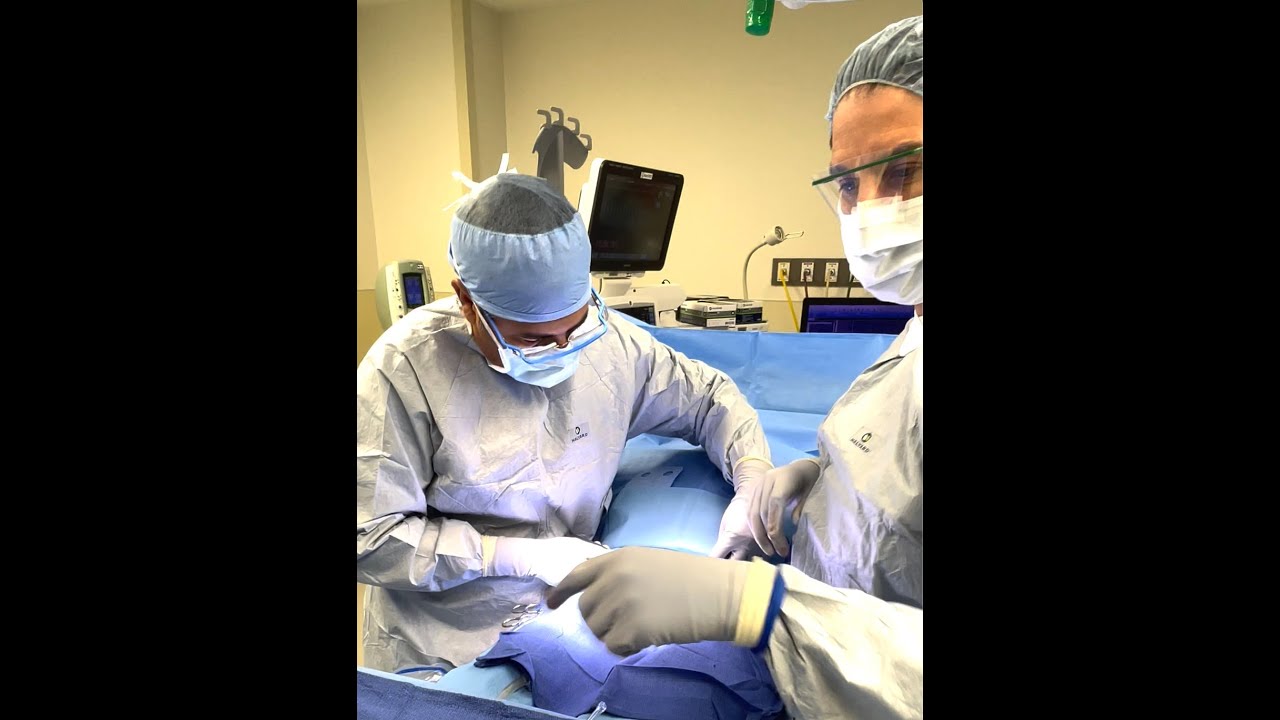
Midline Reservoir Placement · Published 14 November 2022
That is Dr. Robbins’ own demonstration of the technique described above. It is surgical footage, recorded for other surgeons rather than for patients — which is precisely why it is here. A man deciding on this operation is entitled to see the part of it being described to him, and a video with a date on it is a different kind of evidence from a paragraph of claims.
Context
A designation earned on volume, in this operation
Boston Scientific makes the AMS 700, and the designation above is specific to it: it is awarded for inflatable penile prosthesis surgery, on a floor of 25 AMS 700 implants a year, and it has to be re-earned every year rather than granted once. It is a measure of how often this operation is performed here — which is the thing that actually matters when you are choosing who does it.
Dr. Robbins has discussed his reservoir approach with their team many times. The working relationship also runs through his prostate practice, where he sits on the company’s advisory board for BPH and was selected as a GreenLight laser expert — mentioned only to show how long it has run, since neither concerns implants.
To be precise about what that does and does not mean: these are designations, appointments and conversations. Boston Scientific has not endorsed, approved or recommended the reservoir technique described above, and nothing here should be read as saying so. The technique is Dr. Robbins’ own.
Step five
Before you go home
You wake in recovery, you are watched while the anesthetic wears off, and once you are steady you go home — the same day, with someone else driving.
You leave with a dressing in place, prescriptions, and written instructions covering what to do over the following days and what to call us about. As with the pre-operative instructions, those are given to you directly rather than published on a web page, because they depend on you: your medications, your other conditions, and how the operation went.
The implant is not usable yet, and will not be for some weeks. It stays deflated while the tissues heal, and Dr. Robbins activates it and teaches you to use it at a follow-up visit, once he is satisfied with how you have healed. Recovery has its own page: recovery after a penile implant, week by week. The questions you still have about the first weeks are good ones to raise at your consultation.
Common Questions
Frequently Asked Questions
Will I be asleep during penile implant surgery?
Yes. The procedure is performed under general anesthesia, so you are fully asleep and feel nothing during the operation. An anesthesiologist stays with you throughout.
Will I go home with a catheter?
No. Dr. Robbins does not use a urinary catheter for this operation. Many men arrive expecting one, because catheters are common after other urological surgery, so it is worth saying plainly: you go home the same day, without one.
When is the implant activated?
Not on the day of surgery. The device is left deflated while the tissues heal, and you are taught to use it at a follow-up visit once Dr. Robbins is satisfied with your healing. The timing is a clinical judgment made at follow-up rather than a fixed date, and he will tell you where you stand at each visit.
What happens if the device fails later?
An implant is a mechanical device, and mechanical devices can eventually fail. If that happens it can be revised or replaced. Dr. Robbins performs revision surgery, including on implants originally placed by another surgeon. Bring us the history and we will tell you honestly what can be done.
Contact Us
We’re here to help. Schedule your visit or ask a question today.
No question is too small — and nothing you share here surprises us. Reach out however feels easiest.
- Call(305) 672-4222
- Visit12411 Biscayne Boulevard
North Miami, FL 33181 - HoursMonday–Friday, 9:00 am – 5:00 pm

Your message goes to Dr. Robbins’ own team — you’ll hear back within one business day.
Get More Information
Need us sooner? Call (305) 672-4222.
We’re Here When You Need Us
Our Office
Visit us in North Miami, or call to book your appointment.
North Miami
- Address12411 Biscayne Boulevard
North Miami, FL 33181 - Phone(305) 672-4222
- Fax(305) 944-3624
| Monday – Friday | 9:00 am – 5:00 pm |
| Saturday – Sunday | Closed |

Where to go next
All Pages on Penile Implant Surgery
-
Penile Implant Overview
What the device is, how it works, and how Dr. Robbins performs the surgery.
-
Is a Penile Implant Right for You?
Who this operation suits, who it does not, and what it will and will not change.
-
Recovery and Activation
Week by week, and when the implant becomes usable.
-
Cost and Insurance Coverage
What insurance covers, and how you find out before surgery is scheduled.
-
Erectile Dysfunction Treatment
Every option that comes before an implant.
-
Revision and Replacement
Already have an implant that isn’t working — including one placed elsewhere, or an infected one.
Associations
Proud Members Of


