Prostate Health · BPH Treatment
Aquablation Therapy for Benign Prostatic Hyperplasia (BPH) Miami, FL
Robotic, heat-free waterjet surgery for an enlarged prostate — planned on live ultrasound, carried out by a robot, and done in a hospital by Dr. David Robbins, the first urologist to perform Aquablation in South Florida.

See it in the room
Aquablation at Jackson North, in 90 seconds
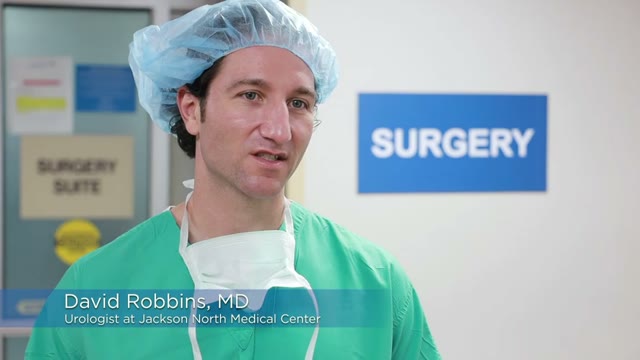
Can I trust him with this?
David Robbins, MD - First Urologist to perform Aquablation in South Florida
David Robbins, MD was asked by PROCEPT BioRobotics to be the first urologist in South Florida to be trained on and be able to offer Aquablation therapy to patients with enlarged prostate (BPH).
Dr. Robbins was trained in Aquablation in 2018 and was the first urologist to perform Aquablation in South Florida. Dr. Robbins teaches minimally invasive approaches to treating the enlarged prostate throughout the United States and internationally.
PROCEPT asked because of the work I was already doing: I have taught minimally invasive prostate surgery to other urologists since 2012 — GreenLight laser courses in Peru, Chile and Colombia among them — and I am a member of Boston Scientific’s Strategic Advisory Board for BPH. My GreenLight work is set out on the GreenLight page. I say that here for one reason: I have both energies in my hands, water and laser, so when I recommend one over the other, it is because of your gland, not my equipment.
Facts you can check
- Diplomate, American Board of Urology (certification ID 17502).
- Florida medical license ME103781.
- NPI 1588848683.
- Teaching surgical technique internationally since 2012.
- In practice at Urological Consultants of Florida since 2009.

In our patients’ own words
After Aquablation
“About two weeks after the operation, I was already urinating a lot better flow than I had been in years.”
“My flow is incredible. I sleep all night long. I can hold it throughout the day, four or five hours without having any issues at all.”
“…for me, it’s a life changer.”
An Aquablation patient of Dr. Robbins, three months after surgery
Shared with the patient’s written permission. Individual results may vary.
“I’m doing perfect, much better than I had hoped. I can urinate totally perfect, sexual function is entirely even better as it was before. I can ejaculate, it’s just wonderful.”
“I’ve been suffering so much before the procedure, and now it’s just like a new life for night and day.”
An Aquablation patient of Dr. Robbins, shortly after surgery
Shared with the patient’s written permission. Individual results may vary.
Why does this keep happening?
If the pill stopped working, it isn’t you
Most men I see for Aquablation have done everything right. They took the alpha-blocker. They put up with the dizziness, or the change in ejaculation. For a while it worked — and then the nights came back: up twice, three times; the stream slower; the feeling that the bladder never quite empties. That is not a failure of willpower or of the pill. The prostate keeps growing, and a medication that relaxes the channel cannot keep up with a gland that is closing it. When the growth is a median lobe — a bulge pushing up into the bladder like a ball in a valve — tablets do very little at all.
Should you actually worry? Three things are medical reasons to act: not being able to urinate at all (retention), bladder stones, and repeated infections — all signs the bladder is being damaged by working against the block. Everything else is quality of life: the sleep, the planning of every drive around a bathroom, the aggravation. In my experience that is reason enough, and it is the reason most men finally come in.
If you are not yet sure your symptoms are BPH, start one step back with the symptoms of BPH and the overview of the enlarged prostate.
What Aquablation is
What is Aquablation Therapy and the AquaBeam System?
PROCEPT BioRobotics developed the AquaBeam Robotic System that delivers Aquablation therapy, a surgical option for the treatment of benign prostatic hyperplasia (BPH). It was the first robotic system granted FDA marketing authorization for the removal of prostate tissue with a fluid jet (De Novo, December 2017), and it has been cleared through the 510(k) process since; the current generation is called HYDROS.
Aquablation combines three things: real-time ultrasound imaging of the whole gland alongside the camera view; a treatment plan the surgeon draws on that image; and a robot that carries the plan out with a high-velocity, heat-free jet of saline. It removes tissue — as the traditional TURP does — but in its randomized trial against TURP it did so with a lower rate of ejaculatory loss (10% vs 36% among sexually active men). It is a hospital procedure under general anesthesia, not an office treatment.

How it works
How does Aquablation Therapy work?
Aquablation therapy is a procedure that combines the clarity of real-time multi-dimensional ultrasound imaging with the precision of an autonomous state of the art surgical robot and heat-free water jet ablation for targeted, controlled, and immediate removal of BPH prostate tissue to optimize surgical outcomes for enlarged prostate and resolve lower urinary tract symptoms (LUTS).
This is a real planning screen from the HYDROS system, with nothing on it that identifies anyone. Before the waterjet starts, the whole prostate is on this screen, seen from the side by an ultrasound probe in the rectum. The horizontal line is the urethra, with the handpiece in it. On a screen like this I place the contour points one at a time, each one a decision about how deep to go at that spot, and the line between them is the deepest the jet will reach — here, 24.3 millimeters. I mark the bladder neck, so the channel is opened all the way through. And I mark the protected zone around the verumontanum, the small ridge where the ejaculatory ducts open into the urethra. The robot will not cross either line. Everything is decided looking at the whole gland, before the cutting starts.
Contour planning · a real screen, walked through

Everything is decided before anything is removed — looking at the whole gland, not during the cutting. That is what makes the plan reproducible from one man to the next.
Aquablation Therapy Provides a Synergistic Solution for Optimal BPH Treatment
The Clarity of Real-time, Multi-dimensional Imaging
Integration of real-time cystoscopic imaging with intra-operative ultrasound provides the surgeon with improved decision-making and personalized treatment planning for each patient.
The Accuracy of an Autonomous Robot
The Aquabeam robotic surgical system executes the treatment plan set up by the surgeon, guiding the precisely aligned heat-free waterjet rapidly and accurately providing reproducible and consistent results.
The Power of a Heat-free Waterjet
Harnessing the intense power of water pulsating at near the speed of sound, Aquablation accurately removes BPH tissue using a heat-free waterjet thereby eliminating thermal injury complications during the procedure.
One of my own cases
What I see before anything is removed
Here is one of my own cases, captured from the system’s screens: the gland before treatment, the plan I drew on it, and the channel afterward. This prostate was over 200 cc. The trials behind Aquablation studied glands up to about 150 mL, so above that size whether it is the right operation is decided man by man, at the evaluation.
The resection
Then the water does exactly that
The robot carries the plan out. The handpiece sweeps a high-velocity jet of saline across the tissue inside the contour, starting at the bladder end and working toward the protected zone, and it stops at the line. In the WATER trial the resection itself took about four minutes on average, against 27 for TURP, inside a procedure of about 33 minutes. Because the jet is heat-free, nothing is burned — and because nothing is burned, bleeding is controlled afterward as a separate step. That is the honest cost of a heat-free cut, and the reason this is done in a hospital.
Robotic resection · scrub the sweep
The obstructing tissue is gone to the depth of the plan; the rim is the line that was drawn. The verumontanum and the ejaculatory ducts, to the right, were never in the plan. Bleeding is then controlled as a separate step.
What would this doctor do?
When Aquablation is my choice — and when it isn’t
I perform and teach several BPH operations, so I have no machine to sell. Here is how I actually think about it.
- The large gland, or the median lobe. Aquablation was studied in prostates from 30 to 150 mL — the randomized WATER trial at 30–80, WATER II at 80–150 — and it handles a median lobe because the plan is drawn around whatever shape is there. For a man whose gland has outgrown the office procedures, this is often where I start the conversation.
- The man who needs tissue removed but wants to keep ejaculation. Rezum and UroLift preserve ejaculation well because they remove nothing — but they were studied in smaller glands. When the gland is too large for them, Aquablation is the tissue-removing option that showed less loss of ejaculation than TURP in a randomized trial. Less is not none: one man in ten in that trial lost it.
- The man who belongs in the office. A moderate gland, no median lobe, a strong wish to avoid a hospital and anesthesia: Rezum or UroLift, under local anesthesia in our North Miami office. I would rather do less when less is enough.
- The man on blood thinners, or who cannot stay overnight. Heat seals vessels as it cuts; water does not. The AUA guideline lists the laser procedures for men at higher bleeding risk, and that is the case where GreenLight laser — which I also perform and teach — is usually my recommendation.
The evaluation decides: a measurement of the gland on ultrasound, a look inside with a flexible cystoscope, a flow test, and your own priorities said out loud.
Every BPH procedure by prostate size · AUA guideline and trial ranges
At 60 mL, the procedures with a guideline or studied range that includes you: Rezum, UroLift, GreenLight laser, Aquablation, TURP. Ejaculation is preserved most often by the office procedures that remove no tissue; among the tissue-removing surgeries, Aquablation showed less loss of ejaculation than TURP in a randomized trial. This is a map of ranges, not a recommendation; the evaluation decides.
Ranges: AUA Guideline on the surgical management of LUTS/BPH (2020 amendment), and each device’s trials and label. Rezum: under 80 mL in the guideline. UroLift: under 80 mL with no obstructive middle lobe in the guideline, and labelled to 100 mL. Aquablation: 30–80 mL in the guideline and in WATER (randomized against TURP); 80–150 mL in WATER II (single-arm). GreenLight laser and TURP: 30–80 g is the guideline’s “average” range, and its 2023 review cites a randomized trial of both in 80–150 g glands. Prostate artery embolization: its guideline statement gives no size range. This panel shows ranges, not a recommendation.
The honest part
Ejaculation, bleeding, and what the trial actually showed
Every tissue-removing BPH surgery cuts a channel. The difference is what happens at the edge of the cut. Heat — laser or an electrical loop — removes tissue and cooks a thin rim around it; that rim seals small vessels, which is useful, and it reaches a little further than the surgeon can see. A waterjet removes tissue mechanically, so the edge is where the plan says it is, and the plan can stop closer to the verumontanum.
At the edge of the cut · two energies, one landmark
Heat does two things at once: it removes tissue and it cooks a thin rim around the cut. That rim seals bleeding — useful — but it also reaches a little further than the surgeon can see. A waterjet removes tissue mechanically, so the edge is where the plan says it is.
What the randomized trial found: among sexually active men, loss of ejaculation in 10% after Aquablation against 36% after TURP (p = 0.0003); at five years, procedure-related ejaculatory dysfunction 7% vs 25%. The AUA guideline calls this advantage theoretical — heat is not used to remove tissue, the mechanism may be the reduced removal near the verumontanum, and cautery used to control bleeding afterward may give some of the advantage back. We quote it that way because that is what is known.
The cost is bleeding. Because the jet does not seal vessels, bleeding is controlled afterward — a balloon catheter under traction, or a brief cautery at the bladder neck. In WATER II, the study of 80–150 mL glands, bleeding needing intervention or transfusion was recorded in 8 of 101 men before discharge and 6 after. In the WATER cohort, one man of 41 who were on antithrombotic medication needed blood products, and none of 75 who were not.
Individual results vary. These are trial averages, quoted so you can weigh them, not promises about you.
The technology
The system in the room
Aquablation is delivered by a robotic system — the HYDROS system pictured here: an ultrasound probe for the picture, a console where the plan is drawn, and a handpiece that carries the jet along the plan. The AquaBeam Robotic System was granted De Novo marketing authorization by the FDA in December 2017 (DEN170024) for the removal of prostate tissue with a fluid jet, with 510(k) clearances since; HYDROS, the current generation, was cleared in 2024 (K240200). Neither is “FDA-approved” — that word belongs to a different pathway, and we use the right one.
- Imaging
- Real-time transrectal ultrasound alongside the camera view, so the plan is drawn on the whole gland, not just what the camera sees.
- Planning
- The surgeon draws the contour, the bladder-neck marker and the protected zone around the verumontanum. The robot will not cross them.
- Resection
- A heat-free, high-velocity saline jet removes the tissue inside the contour, swept robotically along the plan.
- Afterward
- Bleeding is controlled as a separate step — a balloon catheter under traction, or a brief cautery at the bladder neck. Most men stay one night in hospital; some go home the same day.

What happens to me
The day of surgery, and the weeks after
The day. Aquablation is performed at Jackson North Medical Center, under general anesthesia, and takes about an hour in the operating room. You wake with a catheter draining the bladder while the raw channel settles.
Overnight. Most men stay one night in hospital; some go home the same day.
Going home. The manufacturer’s patient information says most men leave the hospital without a catheter; some go home with one for a few days. Your surgeon decides from how your recovery is going.
The first two weeks. Expect mild burning when you urinate, urgency, and some blood in the urine. Light activity is fine; strenuous activity, lifting and sex wait for your surgeon’s go-ahead.
Call us the same day if: you cannot urinate; heavy bleeding or clots that stop the flow; fever or chills; severe pain.
Recovery timeline · and the symptom score the trials followed
In 528 men across five prospective studies, the symptom score fell from 21.5 at baseline to 5.8 at six months and held at 6.6 at a year. The randomized WATER cohort was still at 7.0 at five years. Individual results vary.
Five years, measured — in brief
Aquablation Therapy Clinical Data
The full trial record — WATER, WATER II, the pooled studies, year by year — is on the clinical results page.
Risks, cost, insurance
What can go wrong, and what it costs
Risks, with the trial’s numbers
In the WATER trial, 26% of men after Aquablation and 42% after TURP had an event on the trial’s safety scale at three months (Clavien–Dindo persistent grade 1, or grade 2 or higher). The common ones: burning, urgency, blood in the urine, temporary difficulty urinating, urinary infection. Less common: bleeding that needs intervention or transfusion (counts above) and retention needing a catheter for longer. Rare, and reported in the literature: injury to the rectum from the probe or the jet — which is one reason this is a surgeon’s procedure, not a device’s. Re-treatment: at five years, 95% (WATER) and 97% (WATER II) of men had not needed another BPH operation.
Cost and insurance
Aquablation is covered by Medicare and by most medical insurance plans; our office will confirm your own coverage before anything is scheduled. For a wider picture of cost across BPH options, see our note on modern BPH treatment options.
To request your consultation, please call (305) 672-4222 or contact us online today!
Common questions
Frequently Asked Questions
Does Aquablation remove the median lobe?
Yes. The treatment plan is drawn on the ultrasound image around whatever shape the gland has, including a median lobe pushing into the bladder, and the robot removes the tissue inside that plan. This is one of the reasons it is considered for glands that office procedures are not designed for.
Where is Aquablation performed — can I have it at your office?
No. Aquablation is a hospital procedure, performed under general anesthesia at Jackson North Medical Center. Rezum and UroLift are the BPH procedures we perform in our North Miami office.
How is Aquablation different from TURP?
Both remove tissue. TURP uses an electrical loop; Aquablation uses a heat-free waterjet guided by a plan the surgeon draws on ultrasound. In the randomized WATER trial symptom relief at six months was non-inferior to TURP, safety events were fewer (26% vs 42%), and loss of ejaculation was less common (10% vs 36% among sexually active men). Gilling et al., J Urol 2018.
Aquablation vs Rezum or UroLift — which is better?
They are different tools for different glands. Rezum (water vapor) and UroLift (implants) remove no tissue, are done in the office under local anesthesia, and preserve ejaculation well; they were studied in prostates up to about 80 mL (UroLift is labelled to 100 mL, without an obstructive middle lobe). Aquablation removes tissue, is done in a hospital, and was studied from 30 to 150 mL. Size, shape and what you want to protect decide — see every BPH treatment compared.
Will I lose ejaculation?
Some men do. In the randomized trial, 10% of sexually active men lost ejaculation after Aquablation, against 36% after TURP; at five years, procedure-related ejaculatory dysfunction was 7% vs 25%. The protected zone in the plan is the reason the number is lower; it is not zero.
Will it affect erections?
In the WATER trial, an analysis of men on and off blood-thinning medication found no new erectile dysfunction in either group, and a one-centre UK series found no significant change in erectile-function scores at a year (Whiting et al., World J Urol 2021). Any pelvic surgery carries some risk, and we discuss yours at the consultation.
How long is recovery?
Typically one night in hospital — some men go home the same day — a catheter that usually comes out before you go home, and about two weeks of burning and urgency. Light activity is fine early on; strenuous activity, lifting and sex wait until your surgeon clears you.
Is Aquablation FDA-approved, or is the correct word cleared?
The AquaBeam Robotic System was granted FDA De Novo marketing authorization in December 2017 for the removal of prostate tissue with a fluid jet, and it and the HYDROS system have been cleared through 510(k) since. The correct word is cleared, not approved; the two are different FDA pathways.
How long does it last?
In the randomized WATER trial, symptom improvement held through five years (IPSS 22.9 → 7.0), and 95% of men had not needed another BPH operation; in WATER II (80–150 mL) the figure was 97%. Berjaoui et al., BJUI Compass 2024.
Is Aquablation covered by insurance?
Aquablation is covered by Medicare and by most medical insurance plans; our office will confirm your own coverage before anything is scheduled.
What size prostate can Aquablation treat?
Aquablation is often described as able to treat prostates of any size. The trials ran from 30 to 150 mL (WATER 30–80, randomized; WATER II 80–150, single-arm), and glands above 150 mL have been reported in the literature. Whether it is right for a very large gland is a judgement made at the evaluation; for the largest glands, enucleation or simple prostatectomy are also on the table.
Contact Us
We’re here to help. Schedule your visit or ask a question today.
No question is too small — and nothing you share here surprises us. Reach out however feels easiest.
- Call(305) 672-4222
- Visit12411 Biscayne Boulevard
North Miami, FL 33181 - HoursMonday–Friday, 9:00 am – 5:00 pm

Your message goes to Dr. Robbins’ own team — you’ll hear back within one business day.
Get More Information
Need us sooner? Call (305) 672-4222.
We’re Here When You Need Us
Our Office
Visit us in North Miami, or call to book your appointment.
North Miami
- Address12411 Biscayne Boulevard
North Miami, FL 33181 - Phone(305) 672-4222
- Fax(305) 944-3624
| Monday – Friday | 9:00 am – 5:00 pm |
| Saturday – Sunday | Closed |

Care Path 01 · Enlarged prostate
In This Section
-
Prostate Health
-
Enlarged Prostate (BPH)
Start here: what the prostate does, what BPH is, and how it causes symptoms in the aging male.
-
Symptoms of BPH
Waking up at night, frequency, urgency, hesitancy and urinary retention — the symptoms, explained.
-
BPH Treatment Options
The full range of minimally invasive BPH treatments offered at our clinic, side by side.
-
Rezum for BPH
Minimally invasive water-vapor treatment of the enlarged prostate, with fewer sexual side effects.
-
UroLift for BPH
A minimally invasive, office-based outpatient procedure — an alternative to invasive surgery.
-
GreenLight Laser Surgery
GreenLight laser surgery for the enlarged prostate.
-
Aquablation Clinical Results
The published clinical data supporting Aquablation therapy for BPH.
-
Prostate Artery Embolization
A catheter-based procedure that shrinks the prostate by reducing its blood supply — what it is, who might consider it, and our honest assessment of where it fits.
-
Tratamiento Para la Prostata Agrandada
Associations
Proud Members Of